
 +61 410 152 276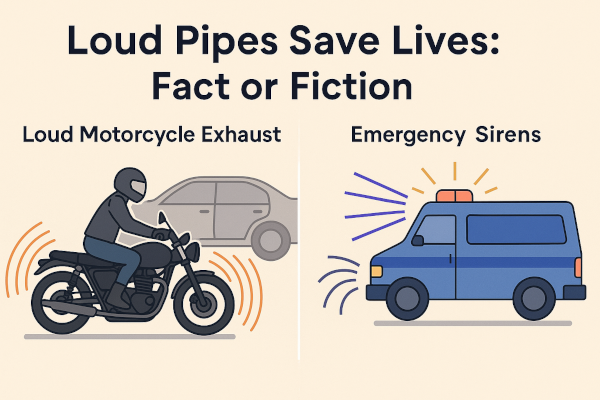
Loud Pipes Save Lives: Fact or Fiction?
Motorcyclists have repeated the phrase “loud pipes save lives” for decades. The theory is simple: if cars can hear you, they’ll notice you and avoid collisions. But does this claim hold up under science? Let’s look at what the evidence says.
The Physics of Sound and Motorcycles
1. Sound Direction
- Motorcycle exhausts are positioned at the rear of the bike.
- Sound energy projects backward, away from the direction of travel.
- Drivers in front — who pose the greatest risk — receive very little sound until the motorcycle has already passed.
2. The Doppler Effect
- As a moving source of sound approaches, the pitch increases; once it passes, the pitch drops.
- In practice, a car driver hears the motorcycle’s exhaust louder after it passes, not before.
- That means the noise comes too late to prevent many common collision scenarios (e.g., cars pulling out of side streets).
3. Car Cabin Insulation
- Modern vehicles have acoustic glass, insulation, and sealed cabins.
- With windows up, air conditioning running, music, and normal road noise, external sounds are heavily muted.
- Studies show external sounds are reduced by 20–30 dB inside a closed car — enough to make a “loud pipe” sound more like background noise until it’s very close.
Research Findings
- NHTSA (US National Highway Traffic Safety Administration): Noise from exhausts does not travel forward effectively enough to increase awareness for most drivers.
- Austroads (Australia): Visibility and conspicuity aids (reflective gear, headlights, positioning) are far more effective safety measures than noise.
- European Commission Report (2018): Excessive motorcycle noise contributes to community complaints but does not measurably reduce collision rates.
What Works Better Than Noise
- High-Visibility Gear: Fluorescent clothing and reflective strips are proven to increase driver awareness.
- Headlight and DRLs: Always-on headlights make motorcycles more noticeable, even in daylight.
- Defensive Lane Positioning: Riding in a dominant track increases your chance of being seen in mirrors.
- Horn Use: A horn projects sound forward — directly into the space where cars are likely to cut across.
So Why Can We Hear Ambulance and Police Sirens?
Many riders argue: “If car drivers can hear emergency vehicles, why wouldn’t they hear my loud exhaust?”
Here’s the difference:
- Frequency Range
- Emergency sirens use oscillating frequencies between ~500 Hz and 1500 Hz.
- These frequencies are specifically chosen because they cut through background noise (traffic, music, wind) and are easier for the human ear to detect.
- Motorcycle exhausts produce lower, droning tones (typically <400 Hz), which blend into road noise and are more easily masked.
- Directionality
- Sirens are mounted on the front of vehicles, projecting sound forward into the path of other road users.
- Exhausts point backward, so the loudest sound is behind the bike — away from the drivers you most need to warn.
- Volume + Regulation
- Sirens are designed to be extremely loud (often 110–120 dB at the source) and legally regulated to ensure they are effective.
- Motorcycle exhausts vary widely, and while some are loud, they aren’t tuned to carry or cut through noise in the same way.
- Visual + Audio Combination
- Emergency vehicles use a multi-sensory approach: flashing lights + sirens.
- Motorcycles with loud pipes often rely on noise alone — a far less effective strategy.
👉 The takeaway: sirens are engineered safety tools, while loud pipes are a byproduct of exhaust modification. They are not comparable.
The Verdict
Loud pipes don’t save lives — they make noise.
They may be heard by pedestrians or vehicles behind you, but they don’t protect you from the real dangers ahead. Science, physics, and crash data all show that visibility, positioning, and defensive riding are the real lifesavers.
At BikeSAFE Motorcycle Training Perth, we focus on evidence-based riding strategies, not myths.