
 +61 410 152 276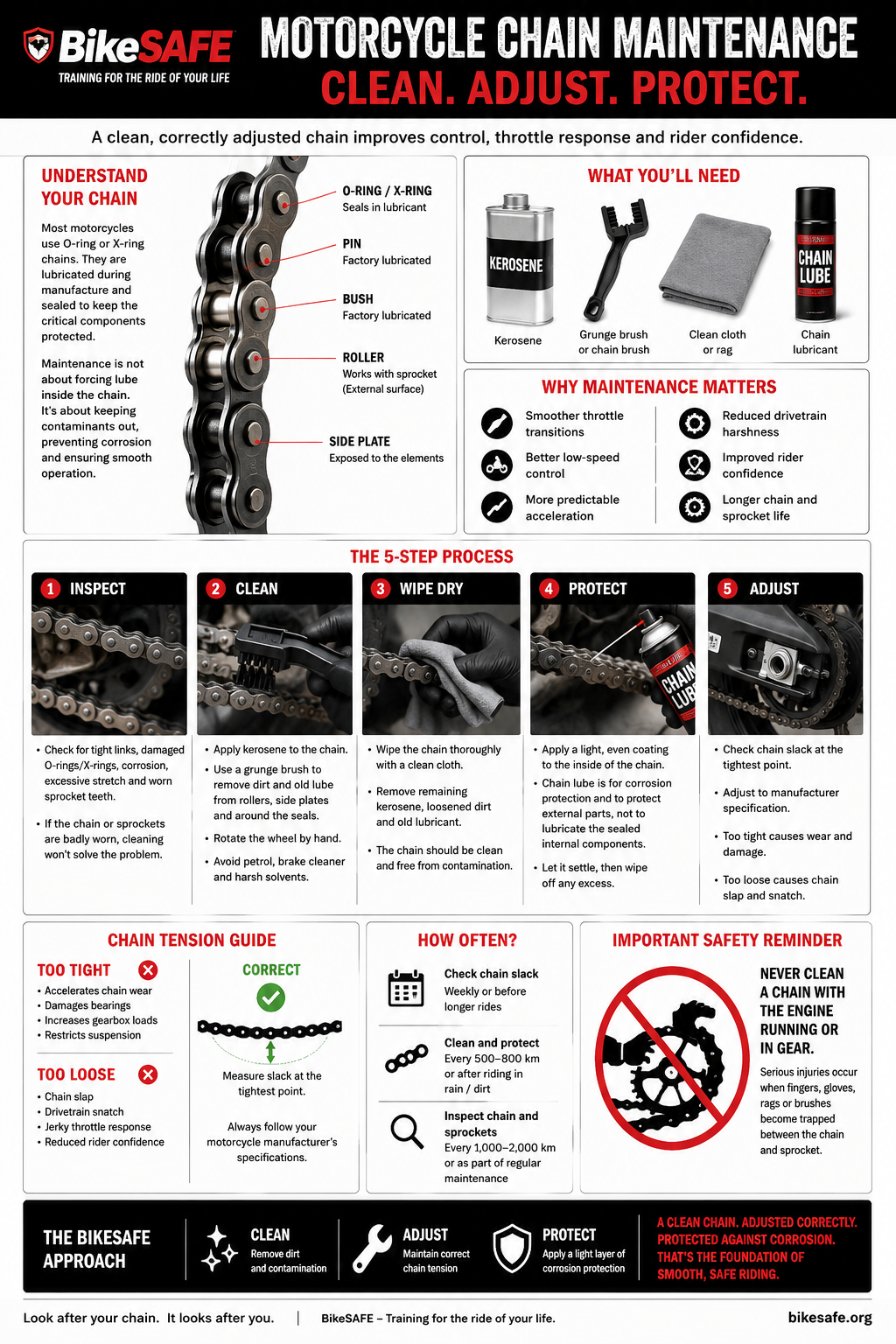
Motorcycle Chain Maintenance: Clean, Adjust, Protect
Category: Motorcycle Maintenance
Motorcycle chain maintenance is one of the most overlooked aspects of motorcycle ownership. Most riders know they should maintain their chain, but many don’t understand what a modern motorcycle chain actually needs.
Chain maintenance isn’t simply about making the chain look clean or applying more lubricant. A properly maintained chain contributes to smooth throttle control, predictable acceleration, reduced drivetrain wear, and improved rider confidence.
Understanding the purpose of chain maintenance helps riders spend less time chasing myths and more time looking after their motorcycle properly.
Understanding the Modern Motorcycle Chain
Most motorcycles are fitted with O-ring or X-ring chains.
These chains are lubricated during manufacture, with grease sealed inside the critical wear surfaces by rubber O-rings or X-rings.
This means the chain’s most important internal components are already lubricated and protected.
The purpose of routine chain maintenance is therefore not to force lubricant into the chain’s sealed internal components. Instead, maintenance focuses on keeping contaminants out, protecting against corrosion, and ensuring smooth operation.
The Real Enemy: Dirt and Grit
Road dirt, dust, sand, and old lubricant are the biggest enemies of chain life.
When dirt mixes with old lubricant it forms an abrasive paste that accelerates wear on:
- Chain rollers
- Sprocket teeth
- O-rings and X-rings
- External chain surfaces
A dirty chain wears faster, runs rougher, and can negatively affect throttle smoothness and drivetrain feel.
For this reason, cleanliness should always be the first priority.
What You’ll Need
Chain maintenance requires only a few simple items:
- Kerosene
- Grunge brush or chain brush
- Clean cloth or rag
- Quality motorcycle chain lubricant
No specialised equipment is required.
Step 1: Inspect the Chain
Before cleaning, inspect the chain and sprockets for signs of wear.
Look for:
- Tight or stiff links
- Damaged O-rings or X-rings
- Corrosion
- Excessive chain stretch
- Hooked or worn sprocket teeth
Cleaning cannot repair a worn-out chain. Inspection should always come first.
Step 2: Clean the Chain
Apply a small amount of kerosene to the chain.
Kerosene is widely regarded as a safe and effective cleaner for O-ring and X-ring chains because it removes dirt and old lubricant without damaging the seals.
Using a grunge brush, rotate the rear wheel by hand and clean:
- Rollers
- Side plates
- Areas around the seals
The objective is not to polish the chain to a showroom finish.
The objective is to remove grit and contamination.
Avoid using petrol, brake cleaner, thinners, or aggressive solvents that may damage chain seals.
Step 3: Wipe the Chain Dry
Once cleaned, wipe the chain thoroughly with a clean cloth.
This removes:
- Remaining kerosene
- Loosened dirt
- Old lubricant residue
The chain should now be clean and free from contamination.
Step 4: Apply Corrosion Protection
Once the chain is clean and dry, apply a quality motorcycle chain lubricant.
Modern O-ring and X-ring chains are already lubricated internally. The purpose of chain lubricant is therefore not primarily to lubricate the chain’s sealed wear surfaces.
Its primary functions are to:
- Protect against corrosion
- Protect exposed rollers and side plates
- Help preserve O-rings and X-rings
- Reduce wear between rollers and sprocket teeth
Apply a light, even coating to the inside of the chain and allow it to settle.
Wipe away any excess lubricant.
The goal is not to leave the chain dripping with lubricant. The goal is to leave it protected by a thin layer of corrosion protection.
Step 5: Check Chain Tension
Correct chain tension is just as important as cleanliness.
A chain that is too tight can:
- Accelerate chain wear
- Damage bearings
- Increase gearbox output shaft loads
- Restrict suspension movement
A chain that is too loose can:
- Cause chain slap
- Increase drivetrain snatch
- Create jerky throttle response
- Reduce rider confidence
Always adjust chain slack according to the motorcycle manufacturer’s specifications.
When checking tension, rotate the wheel and find the chain’s tightest point before measuring slack.
Why Riders Should Care
Many riders view chain maintenance as a mechanical task.
In reality, it directly affects the riding experience.
A clean, correctly adjusted chain helps provide:
- Smoother throttle transitions
- Better low-speed control
- More predictable acceleration
- Reduced drivetrain harshness
- Improved rider confidence
When riders describe a motorcycle as feeling smooth and easy to ride, a well-maintained chain is often part of the reason.
Safety Warning
Never clean a chain with the motorcycle running or in gear.
Serious injuries occur when fingers, gloves, rags, or brushes become trapped between the chain and sprocket.
Always rotate the rear wheel by hand with the engine switched off.
No maintenance task is worth losing a finger.
The BikeSAFE Approach
Forget the myth that more lubricant automatically means better maintenance.
Instead, remember three simple principles:
Clean
Remove dirt, grit, and contamination.
Adjust
Maintain correct chain tension.
Protect
Apply a light coating of lubricant to prevent corrosion and protect exposed components.
Final Thought
Modern motorcycle chains are sealed internally but exposed externally.
The key to long chain life is not excessive lubrication. It is keeping the chain clean, correctly adjusted, and protected against corrosion.
A clean chain, adjusted correctly and protected by a light coating of lubricant, contributes to smoother throttle control, more predictable handling, and a safer, more enjoyable ride.
Because if the chain isn’t smooth, neither is your riding.