
 +61 410 152 276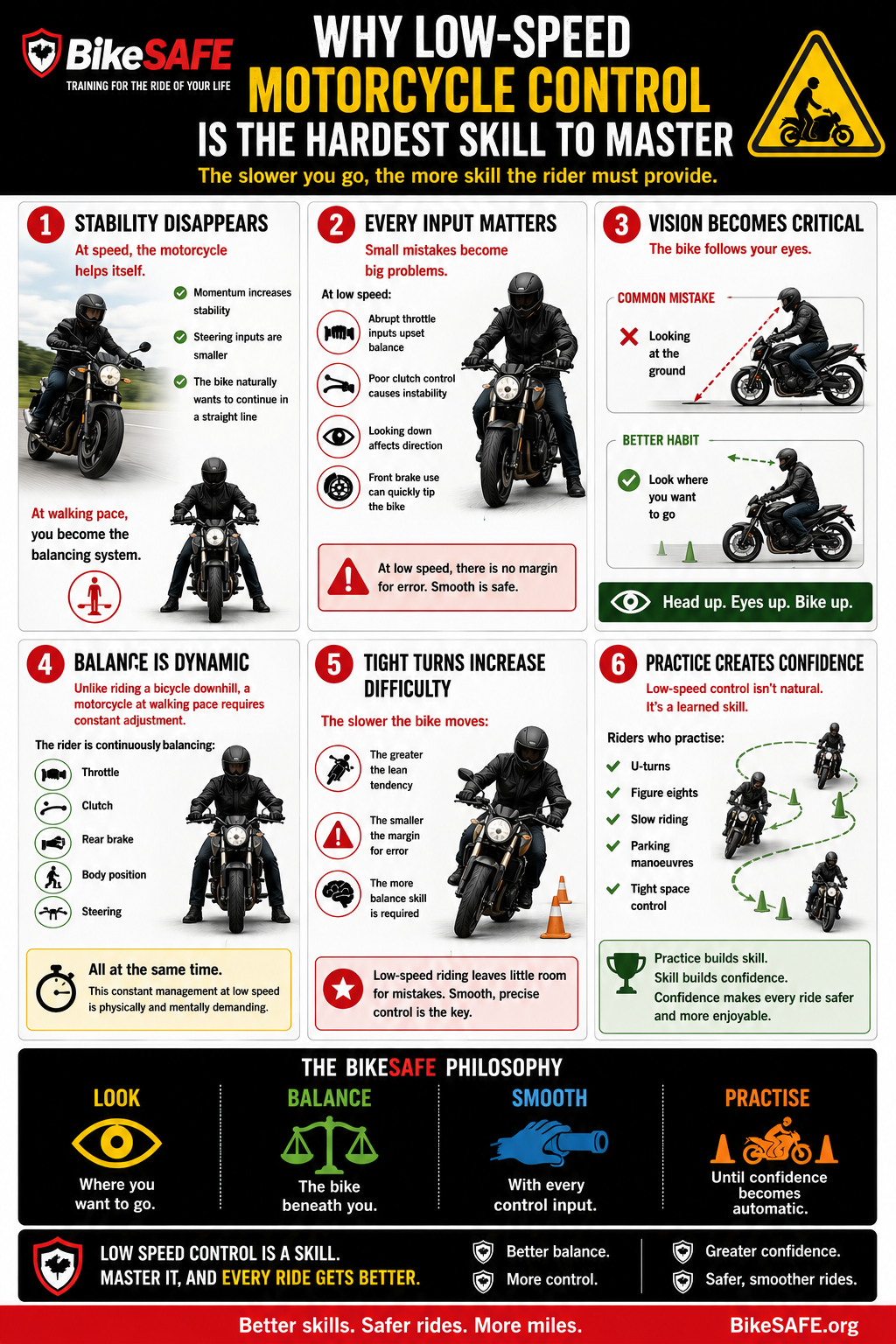
Why Low-Speed Motorcycle Control Is the Hardest Skill to Master
Ask most learner riders what scares them the most, and surprisingly, it’s rarely high-speed riding. Instead, it’s slow-speed control — U-turns, tight manoeuvres, car parks, roundabouts, and stop-start traffic.
At BikeSAFE Motorcycle Training in Perth, we see this every day. Riders who feel confident once they’re moving often struggle the moment the speed drops. There’s a good reason for this: motorcycles are least stable at low speed.
Why Motorcycles Are Unstable at Low Speed
At speed, a motorcycle benefits from momentum and gyroscopic stability. The faster the wheels spin, the more naturally the bike wants to stay upright.
At walking pace, that stability disappears. Balance now relies almost entirely on rider input — clutch control, throttle, rear brake, body position, and vision. Any abrupt input is magnified.
This is why low-speed riding feels difficult and unforgiving, especially for beginners.
The Key Skills That Control the Bike at Low Speed
Clutch Control and the Friction Zone
Low-speed riding lives in the friction zone. The clutch is rarely fully engaged or fully disengaged — instead, it is fed power in a controlled, deliberate manner.
Smooth clutch control allows the engine to deliver usable drive without jerks, stalls, or panic reactions. When clutch control is poor, balance disappears quickly and confidence drops just as fast.
Rear Brake for Stability
At low speed, the rear brake is a stabilising tool, not a stopping tool. A light rear brake application settles the chassis, slows steering response, and gives the rider time to think and adjust.
Using the front brake at walking pace — particularly with the handlebars turned — often leads to sudden loss of balance and low-speed tip-overs.
Throttle Control: Steady, Not Reactive
At low speed, throttle input should be steady and predictable. Sudden changes in engine speed upset balance and trigger instinctive reactions.
At BikeSAFE, we teach riders to hold a small, consistent amount of throttle and regulate speed using the clutch and rear brake instead.
Fear of Engine Revs: A Hidden Barrier for Learners
One of the most common fears new riders experience is the sound of the engine revving.
Many learners associate higher engine noise with:
- mechanical abuse
- loss of control
- “doing something wrong”
This fear often comes from car driving habits, where revving and clutch slip are discouraged. On a motorcycle, this thinking needs to be reframed.
Dry Clutch vs Wet Clutch: Why Motorcycles Are Different
Dry Clutch (Typical in Cars)
Car clutches are usually dry clutches, designed to engage quickly and operate with minimal slipping. Excessive clutch slip causes heat and wear, which is why drivers are taught to avoid it.
That discipline is correct — for cars.
Wet Clutch (Most Motorcycles)
Most motorcycles use a wet clutch, running in engine oil. This design:
- allows controlled slipping
- dissipates heat effectively
- is engineered specifically for low-speed control
Motorcycles are designed to be ridden in the friction zone. Controlled clutch slip combined with steady revs is normal, safe, and expected.
Engine noise does not equal danger — poor control does.
The Misconception: “Brakes Are Only for Slowing and Stopping”
Another deeply ingrained belief many learners bring with them is that brakes exist only to slow down or stop. This assumption comes almost entirely from car driving experience.
On a motorcycle — especially at low speed — this belief is incomplete.
At BikeSAFE, we teach riders that brakes, particularly the rear brake, are also a control and stability tool.
Brakes as a Control Input, Not Just a Stop Button
At low speed, the rear brake:
- stabilises the motorcycle’s chassis
- reduces sudden acceleration from throttle inputs
- slows steering response
- gives the rider time to think and adjust
A light rear brake application creates resistance against the drivetrain, allowing smoother clutch engagement and steadier balance.
This is why riders who rely only on clutch and throttle often feel unstable, while riders who introduce rear brake modulation feel calmer and more in control.
Why This Feels Counterintuitive
Many learners subconsciously believe:
- braking = danger
- braking mid-manoeuvre = mistake
- braking at low speed = loss of control
In reality, at walking pace, not using the rear brake often causes more instability than using it.
The front brake is different. Applied at low speed with steering input, it can abruptly collapse balance — reinforcing fear and confusion.
Understanding which brake to use, when, and why is critical to low-speed mastery.
How Clutch, Throttle, and Rear Brake Work Together
At low speed:
- Throttle sets available power
- Clutch meters that power
- Rear brake fine-tunes speed and stabilises balance
These controls work together as a system. None of them operate in isolation.
Trying to ride slowly using throttle alone is like trying to balance on a tightrope without a pole — possible, but unnecessarily difficult.
Where Instinct Works Against You
When riders feel uncertain or threatened, instinct often causes:
- tight grip on the handlebars
- stiff arms and shoulders
- eyes dropping to the ground
- abrupt control inputs
These reactions remove stability instead of restoring it. Relaxed arms, steady revs, controlled clutch use, and light rear brake input give the motorcycle a chance to self-balance.
Vision and Head Position
The motorcycle follows your eyes.
At low speed:
- look where you want to go
- turn your head early and deliberately
- keep your chin level and eyes up
This single adjustment often transforms U-turns and tight manoeuvres almost immediately.
Why Low-Speed Mastery Builds Overall Confidence
Riders who master low-speed control:
- drop bikes less often
- feel calmer in traffic
- perform better in practical riding assessments
- ride more smoothly at higher speeds
Low-speed skills form the foundation for everything else. Without them, riders rely on speed to feel stable — a habit that increases risk.
Final Thoughts
Low-speed motorcycle control is hard because it demands precision, patience, and trust — trust in the machine and trust in correct technique.
Understanding that motorcycles are designed for:
- controlled clutch slip
- moderate engine revs
- deliberate rear brake use
removes a major psychological barrier for learners.
At BikeSAFE Motorcycle Training Perth, we don’t just teach riders how to pass a test — we teach them how to understand what the motorcycle is designed to do, and how to work with it rather than against it.