
 +61 410 152 276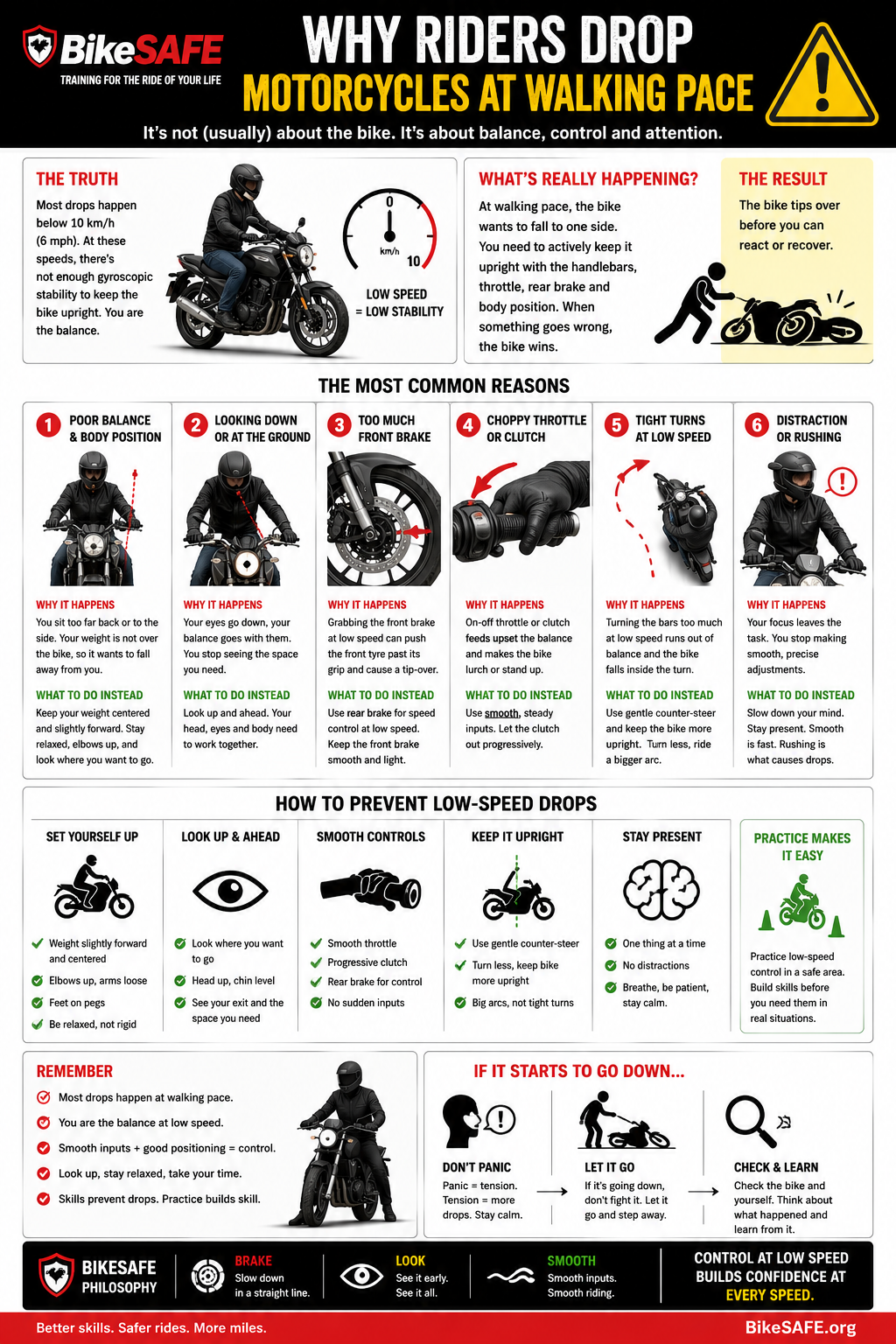
Why Riders Drop Motorcycles at Walking Pace
Understanding the Real Causes of Low-Speed Falls
One of the most confusing and frustrating experiences for new riders is dropping a motorcycle at walking pace. Riders often say things like, “I wasn’t even going fast” or “It just fell over.” The reality is that most motorcycle drops don’t happen at speed — they happen when control, balance, and confidence break down at very low speeds.
At BikeSAFE Motorcycle Training Perth, this is one of the most common patterns we see during motorcycle lessons, particularly with new learners.
The Myth: “Slow Means Safe”
At higher speeds, motorcycles are naturally stable. Gyroscopic forces from the wheels help keep the bike upright, and small rider inputs are smoothed out by momentum.
At walking pace, those stabilising forces disappear.
This means:
- Balance becomes an active skill, not a passive one
- Small mistakes have big consequences
- Hesitation and fear play a much larger role
Slow speed riding is actually harder, not easier.
The Most Common Reasons Motorcycles Are Dropped at Low Speed
1. Looking Down Instead of Where You Want to Go
When riders feel uncomfortable, they instinctively look down at the ground, the front wheel, or their feet.
The problem:
- The bike follows your eyes
- Looking down destroys balance
- Steering input becomes jerky and inconsistent
At walking pace, head and eye position is everything.
2. Cutting the Throttle Instead of Managing It
Many learners are uncomfortable hearing the engine rev. There’s an ingrained belief that:
- Revs are “bad”
- Noise means loss of control
- Throttle should be closed when things feel unstable
In reality:
- Closing the throttle removes stability
- The bike loses drive
- Balance collapses instantly
Low-speed control requires steady throttle, not zero throttle.
3. Fear of “Slipping the Clutch”
Car drivers are taught not to ride the clutch. That discipline carries over — incorrectly — to motorcycles.
On a motorcycle:
- The clutch is designed to be slipped
- Most bikes use a wet clutch, bathed in oil
- Controlled clutch slip is essential at low speed
Refusing to slip the clutch leads to:
- Jerky power delivery
- Stalling
- Panic foot dabs
4. Poor Foot Management
A very common sequence:
- Bike slows
- Rider panics
- Both feet come off the pegs
- Weight shifts unpredictably
- Bike tips past the balance point
Once the bike leans too far at walking pace, no amount of strength will save it.
Good low-speed riders:
- Keep feet on pegs as long as possible
- Put one foot down only when necessary
- Commit to the decision, not hesitate
5. Tensing Up and the “Death Grip”
Fear causes muscle tension.
This shows up as:
- Locked arms
- White-knuckle grip on the bars
- Stiff shoulders
- Over-steering
A motorcycle needs to move beneath the rider.
When the rider locks up, the bike has nowhere to go but down.
6. Misunderstanding Brake Use at Low Speed
Many riders think brakes are only for slowing or stopping.
At low speed:
- The rear brake is a stabiliser
- Light rear brake settles the chassis
- It smooths throttle and clutch input
Grabbing the front brake at full lock, however, is one of the fastest ways to drop a bike at walking pace.
Why Fear Makes It Worse
Fear causes:
- Hesitation
- Delayed decisions
- Conflicting inputs
The motorcycle responds immediately — fear does not.
This mismatch is why many low-speed drops feel sudden and unavoidable, even though the warning signs were there.
The Key Takeaway
Motorcycles are not dropped at walking pace because riders are “bad” or “unskilled”.
They are dropped because:
- Low-speed riding is misunderstood
- Fear overrides technique
- Riders remove stability instead of adding it
Low-speed control is a learned skill, not an instinctive one — and once properly understood, it becomes predictable and repeatable.
Final Thought
Every confident rider you see once struggled with low-speed control.
The difference is not talent —
it’s training, understanding, and structured practice.