
 +61 410 152 276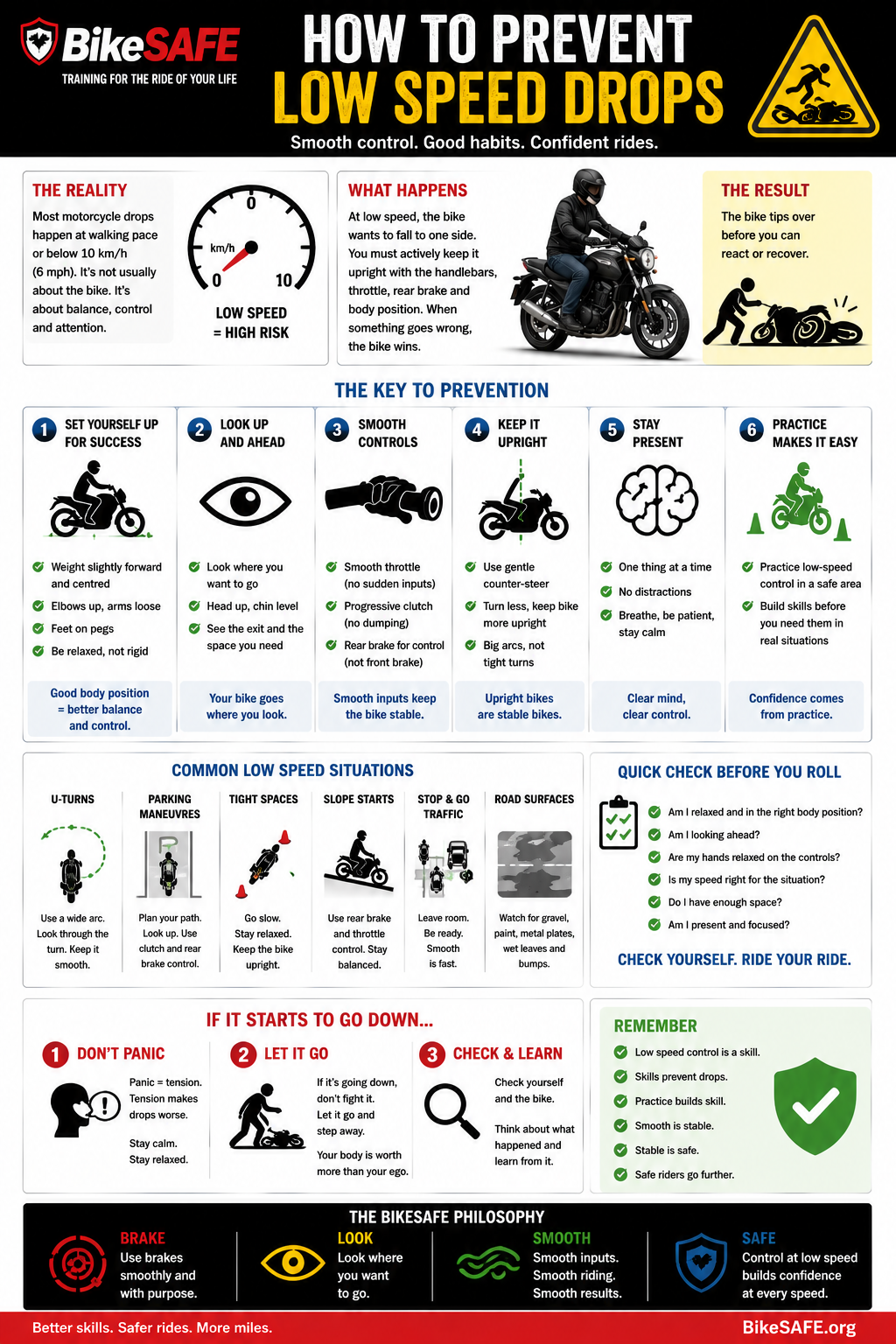
How to Prevent Low-Speed Motorcycle Drops
A Simple Control Framework That Works
After understanding why motorcycles are unstable at low speed and why riders commonly drop them at walking pace, the next question is obvious:
How do you stop it from happening?
At BikeSAFE Motorcycle Training Perth, we don’t rely on vague advice like “just relax” or “take it easy.” Low-speed riding requires a repeatable control framework — something riders can apply consistently, even when nervous.
The Low-Speed Control Framework
When riding at walking pace, every input matters. The key is not strength or bravery, but structure.
Think of low-speed control as five elements working together.
1. Eyes First — Vision Leads Everything
Low-speed balance begins with vision.
- Look where you want the motorcycle to go
- Turn your head early and deliberately
- Keep your eyes up, not on the ground or front wheel
If your eyes drop, your balance follows.
This is the single fastest fix for low-speed instability.
2. Steady Throttle — Set the Power Once
At low speed, throttle is not for speed control — it is for engine stability.
- Hold a small, steady throttle (often around twice idle)
- Do not chase speed with the throttle
- Avoid chopping the throttle when things feel uncertain
A stable engine gives you predictable drive. Unstable throttle creates panic.
3. Clutch Controls Movement — Not the Throttle
Speed at walking pace is controlled by the clutch, not the throttle.
- Use the friction zone deliberately
- Feed power in smoothly
- Allow controlled clutch slip — this is normal on a wet clutch motorcycle
Trying to ride slowly with the clutch fully out removes your ability to fine-tune movement.
4. Rear Brake Adds Stability
At low speed, the rear brake is not just for stopping.
A light rear brake:
- settles the chassis
- slows steering response
- smooths throttle and clutch input
- buys thinking time
Used correctly, the rear brake adds stability, not danger.
Avoid front brake use at full steering lock — this is one of the most common causes of low-speed drops.
5. Body and Hands — Relax to Let the Bike Work
Low-speed riding exposes tension immediately.
- Light grip on the handlebars
- Bent elbows, relaxed shoulders
- Let the bike move underneath you
A motorcycle needs freedom to balance. Locked arms and a death grip remove that freedom.
Putting It All Together
At walking pace:
- Eyes lead
- Throttle stays steady
- Clutch meters power
- Rear brake stabilises
- Body stays relaxed
Remove any one of these, and control degrades quickly.
This is why low-speed riding feels difficult when approached instinctively — instincts usually remove stability instead of adding it.
Practising the Framework Safely
Low-speed skills should be practised:
- in a controlled environment
- at deliberately slow speeds
- with repetition, not force
Rushing the process only reinforces fear and poor habits.
Final Thought
Motorcycles are rarely dropped at walking pace because riders lack courage or ability.
They are dropped because riders lack structure.
Once low-speed riding is approached as a system — rather than a reaction — confidence increases rapidly, and drops become the exception, not the rule.